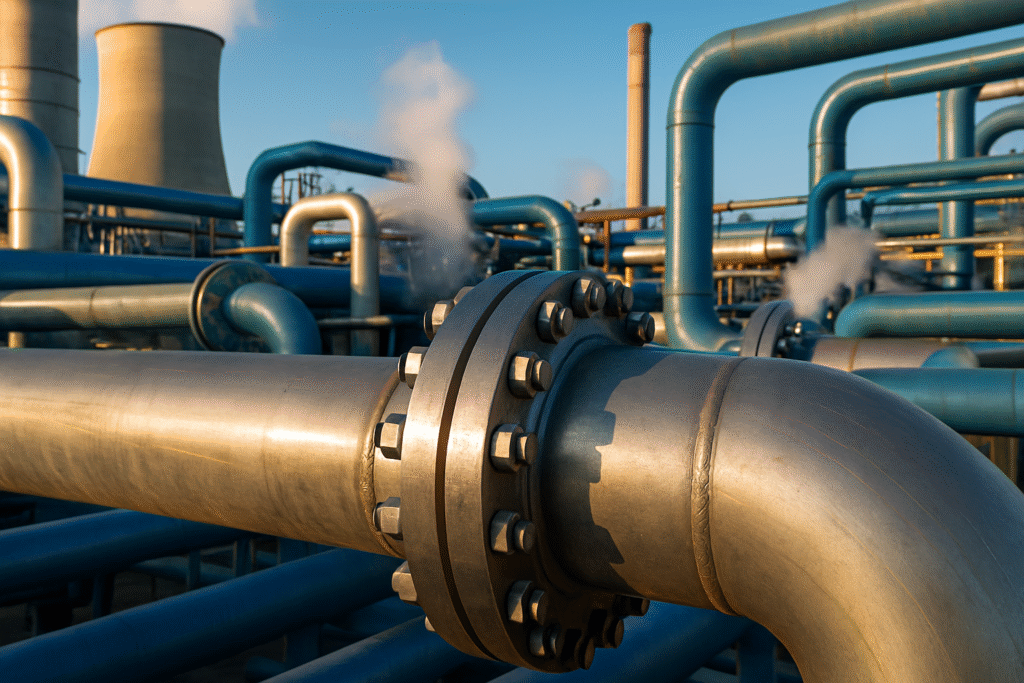
Der Markt für Edelstahlrohrflansche liegt bei 5,8 Milliarden US-Dollar: Versteckte Vorteile, Typen, Verwendungsmöglichkeiten, und wie man die gängigsten verschiedenen Flansche auswählt
Der Markt für Edelstahlrohrflansche steht im Mittelpunkt der modernen Prozessrohrleitung, und die Nachfrage im Energiebereich steigt weiter an, Wasser, und Meeresprojekte. Laut Grand View Research (2024), Der globale Markt für Industrieflansche wurde mit bewertet $5.8 Milliarden in 2023 und wird voraussichtlich erreicht werden $7.2 Milliarden von 2030, which highlights why buyers are comparing the hidden advantages, Typen, verwendet, and how to choose the most common different flanges more carefully.
Für Ingenieure und Einkaufsmanager, the real decision is not only material selection. It is also about pressure class, Korrosionszuschlag, Verblendungstyp, Rückverfolgbarkeit, Vorlaufzeit, und Lieferantenqualitätssysteme.
In diesem Artikel, we examine what makes a stainless steel pipe flange strategically valuable in industrial service. We also explain where SASA FLANGE fits into global sourcing with ISO 9001:2015 und PED 2014/68/EU-Zertifizierungen, breite Legierungsabdeckung, and factory-direct manufacturing in China.
Why the stainless steel pipe flange market keeps expanding across industrial sectors
Laut IBISWorld (2024), Der asiatisch-pazifische Raum macht mehr als aus 45% der weltweiten Flanschproduktion, wobei China der größte Hersteller ist. daher, buyers worldwide increasingly depend on qualified Chinese suppliers for stable output, competitive cost, and short production cycles.
Laut Statista (2024), auf die Öl- und Gasindustrie entfallen ca 35% des weltweiten Flanschverbrauchs. This concentration matters because upstream, Mittelstrom, and refining systems demand high-integrity joints that can tolerate vibration, Druckwechsel, und korrosive Medien.
Stainless steel pipe flange demand is also tied to stricter lifecycle cost analysis. While carbon steel often carries a lower initial price, stainless grades usually reduce replacement frequency, coating maintenance, and unplanned shutdown risk in corrosive services.
Laut Mordor-Geheimdienst (2024), global water and wastewater infrastructure spending continues to expand as urbanization and reuse projects increase. Infolge, 304, 316, and duplex stainless flanges are seeing broader adoption in desalination skids, treatment plants, and chemical dosing lines.
The most common different flanges used in these sectors include weld neck, reinschlüpfen, blind, Muffenschweißen, und Gewindeausführungen. Jedoch, the right choice depends on mechanical loading, process hazard, Montagemethode, and future inspection access.
Material selection remains equally important. A 304 or 304L stainless steel pipe flange works well for many atmospheric and mild chemical environments, während 316 or 316L performs better in chloride-bearing conditions because molybdenum improves pitting resistance.
For severe service, engineers often move toward 904L, Duplex 2205, Super-Duplex 2507, oder Nickellegierungen. ASTM and ASME material frameworks provide the basis for consistent chemistry, mechanische Eigenschaften, und Testdokumentation (ASTM, ASME).
Als ASME states through its B16 standards framework, Flanschabmessungen, Toleranzen, Bohren, and pressure-temperature ratings must be controlled to maintain interchangeability and safety (ASME, 2023). That is why specification discipline matters more than marketing language.
In practical sourcing, buyers also want visible manufacturing competence. SASA FLANGE unterstützt Projekte mit Edelstahlflanschen, Flansche aus Kohlenstoffstahl, Flansche aus Legierung, und Rohrverschraubungen 304, 316, 316L, 904L, 2205, 2507, A105, A182, Inconel, Monel, Hastelloy, und Titan, backed by CNC machining and inspection systems.
Darüber hinaus, global EPC contractors now require stronger traceability. EN 10204 3.1 Zertifikate, PMI, Maßprüfung, hydrotesting support, and heat number control are no longer optional in many projects.
Laut Market Research Future (2024), industrial piping component demand is being supported by energy transition investment, LNG-Terminals, and process plant upgrades. Folglich, buyers who understand hidden advantages such as corrosion resistance, Reinigbarkeit, and long-term sealing performance can reduce total installed cost.
That is where a stainless steel pipe flange stands out. It combines structural connection, Wartbarkeit, and material durability in one component that directly affects plant reliability.
Arten von Rohrflanschen aus Edelstahl, Materialien, and hidden advantages in demanding service
Ein Edelstahlrohrflansch ist keine einzelne Produktkategorie. It is a family of engineered connection components designed around pressure class, Ende der Vorbereitung, Flanschfläche, Metallurgie, und Servicebedingungen.
As John Bickford, mechanical joint design specialist, Staaten: “A flange selection error is rarely visible at installation, but it becomes very visible during thermal cycling, Entspannung der Dichtung, and corrosion exposure.” That observation explains why experienced buyers evaluate flange geometry and service history together.
Laut Grand View Research (2024), maintenance reduction and process reliability remain major purchasing drivers in industrial flow systems. daher, stainless steel flanges often win in applications where downtime costs exceed the initial material premium.
According to NACE and ISO corrosion guidance, chloride-rich and sour environments can accelerate localized attack if the wrong alloy is selected (NACE, ISO). Im Gegensatz, properly selected 316L, Duplex 2205, oder Super-Duplex 2507 grades can significantly improve resistance in marine and chemical duties.
The most common different flanges each solve a different engineering problem. Weld neck flanges distribute stress efficiently through their tapered hub, while slip on flanges simplify alignment and fabrication in lower-demand services.
Blind flanges close off nozzles and future expansion points. Socket weld flanges support small-bore, Hochdruckbetrieb, and threaded flanges allow assembly where welding should be avoided.
- Vorschweißflansch: bevorzugt für Hochdruck, Temperaturwechsel, und kritische Prozesslinien.
- Aufsteckflansch: economical for moderate pressure systems with easier fit-up.
- Blindflansch: zur Isolierung verwendet, hydrotest points, and maintenance shutdowns.
- Muffenschweißflansch: common in smaller diameters with high-pressure duty.
- Gewindeflansch: geeignet, wenn das Schweißen eingeschränkt ist oder die Montage vor Ort vereinfacht werden muss.
Facing type is another hidden advantage area that many buyers underestimate. Raised face remains the most common, ring type joint serves high-pressure and high-temperature duties, and flat face is often selected for cast iron or low-bolt-load systems.
Material grade selection should follow actual media and temperature, keine Gewohnheit. Zum Beispiel, 304 and 304L are widely used for general corrosion resistance and fabrication ease, Aber 316 and 316L usually perform better in coastal plants, chemische Dosiersysteme, and brackish water service.
For stronger chloride resistance and higher strength, duplex and super duplex grades become attractive. They often enable wall thickness reduction while improving pitting and crevice corrosion performance.
Als Dr. Fontana, corrosion engineering authority, noted: “Corrosion control begins with correct material selection rather than repair strategy.” That principle remains highly relevant when specifying stainless steel pipe flange assemblies for seawater, Säuren, or aggressive condensate lines.
There are also procurement advantages beyond metallurgy. Stainless components often support cleaner surface finish requirements, better hygiene compatibility, and lower coating management effort in food, Pharma, and ultrapure water systems.
- 304/304L: versatile and cost-effective for general industrial service.
- 316/316L: improved pitting resistance due to molybdenum content.
- 904L: higher resistance in aggressive chemical environments.
- 2205 Duplex: higher strength with good chloride resistance.
- 2507 Super-Duplex: enhanced resistance for severe marine and offshore duty.
Entsprechend ASTM A182, forged or rolled alloy and stainless steel pipe flanges must meet specific chemical and mechanical property requirements for high-temperature service (ASTM, 2023). That specification is foundational for many stainless steel pipe flange procurements.
Pressure class also influences design choices. ANSI/ASME B16.5 deckt gängige Klassen ab, z 150, 300, 600, 900, 1500, Und 2500 für Standardgrößen, während ASME B16.47 adressiert größere Durchmesser.
Mit ISO 9001:2015 und PED 2014/68/EU-Zertifizierungen, SASA FLANGE supports buyers who need controlled manufacturing, EN 10204 3.1 Dokumentation, and export-ready quality packages. The company offers custom sizes from 1/2 Zoll zu 60 inch and serves Oil & Gas, Petrochemie, Leistung, Marine, and Water Treatment sectors in 50+ Länder.
Zusätzlich, flange selection increasingly includes lifecycle criteria. A lower-cost component that fails early creates far higher costs through leaks, shutdowns, bolt replacement, insulation removal, and labor exposure.
That is why experienced sourcing teams compare more than price. They compare metallurgy, Bearbeitungsqualität, face finish control, bore accuracy, Inspektionsfähigkeit, und Reaktionsfähigkeit der Lieferanten.
ASME, ASTM, DIN, and EN standards that define stainless steel pipe flange compliance
Industrial buyers should treat standards compliance as the baseline, not the premium tier. A stainless steel pipe flange must match the dimensional, Druck-Temperatur, Material, and documentation requirements in the project specification.
ASME B16.5 is the leading standard for pipe flanges and flanged fittings in NPS 1/2 durch 24. ASME B16.47 extends coverage for large-diameter steel flanges, which is essential in pipelines, Wasserübertragung, und Prozessversorgungssysteme (ASME, 2023).
ASTM A182 Regelt üblicherweise geschmiedete Flansche aus rostfreiem und legiertem Stahl. ASTM A240 applies to plate products, which is relevant when evaluating forged versus plate flange construction for certain sizes and pressure ranges.
European and international projects frequently call for EN 1092-1, DIN formats, or ISO-aligned requirements. daher, suppliers must be able to manufacture across ANSI, DIN, JIS, GOST, and EN systems without dimensional ambiguity.
- ASME B16.5: Abmessungen, Toleranzen, Bohren, facings, and ratings for common flange sizes.
- ASME B16.47: large-diameter steel flanges for demanding industrial systems.
- ASME B16.9: butt weld fittings such as elbows, T-Shirts, Reduzierstücke, und Mützen.
- ASTM A182: geschmiedete oder gewalzte Flansche und Armaturen aus Legierung und Edelstahl.
- EN 1092-1: Europäischer Flanschstandard, der bei Exportprojekten weit verbreitet ist.
- NACE MR0175 / ISO 15156: material suitability guidance for sour service environments.
Pressure-temperature rating must always be checked against material group and standard tables. Eine Klasse 150 flange in one alloy and temperature band does not automatically carry the same usable limit in another service condition.
Zusätzlich, compliance today extends beyond dimensions. Dokumentation PED 2014/68/EU, ANZEIGE 2000 Anforderungen, and client-mandated PMI or ferrite control can all affect final acceptance.
Für die Beschaffung von Edelstahlrohrflanschen, test and document control often decide supplier approval. Buyers commonly request mill test certificates, Härteprüfungen, positive Materialidentifikation, Sichtprüfung, dimensionale Berichte, and sometimes radiography support for associated weldments.
Gemäß DNV-Richtlinien für Offshore- und Meeressysteme, documentation quality and traceability are central to safety-critical component acceptance (DNV, 2023). This is especially important for duplex and super duplex materials, where heat treatment and chemistry control directly affect corrosion behavior.
A practical compliance review should include the following checkpoints before purchase order release.
- Standard bestätigen: ASME B16.5, B16.47, EN 1092-1, DIN, or project-specific code.
- Materialqualität bestätigen: 304, 316L, 904L, 2205, 2507, or nickel alloy as required.
- Confirm pressure class or PN rating and service temperature.
- Confirm facing type: RF, FF, RTJ, or special finish requirement.
- Confirm certification package: EN 10204 3.1, PED, PMI, NACE, or client forms.
- Confirm inspection and marking: Hitzezahl, Größe, Bewertung, Standard, und Herkunftsrückverfolgbarkeit.
Unterstützt durch fortschrittliche CNC-Bearbeitung und umfassende Qualitätsprüfungen, SASA FLANGE manufactures to ANSI B16.5, ANSI B16.47, ASME B16.9, DIN, JIS, GOST, und EN 1092 Anforderungen. Buyers can also review the company profile and capability overview at https://www.sasaflange.com/about-us/.
Für gemischte Pakete, the ability to source flanges and fittings together also reduces project complexity. That matters when schedules are tight and each missing reducer or blind flange can delay hydrotest or commissioning.
How to choose stainless steel pipe flange sizes, Bewertungen, and materials for real applications
Choosing the right stainless steel pipe flange begins with service conditions, keine Katalogpräferenz. The engineer must define fluid chemistry, Auslegungsdruck, Betriebstemperatur, zyklische Belastung, äußere Umgebung, und Wartungsstrategie.
Oil and gas service often prioritizes weld neck flanges in ASTM A182 F316/F316L, Duplex 2205, oder Super-Duplex 2507, depending on chlorides and sour gas exposure. Because the sector represents about 35% des weltweiten Flanschverbrauchs, proven reliability in this environment strongly influences global design norms (Staatsmann, 2024).
Chemical processing systems may need 316L, 904L, Hastelloy, or Monel to handle acids, Lösungsmittel, or chloride-bearing streams. In diesen Fällen, crevice corrosion resistance and gasket compatibility are just as important as nominal pressure class.
Power generation projects often combine stainless and alloy flanges with high-temperature fittings. Wärmeausdehnung, Kondensatchemie, and startup-shutdown cycles can all affect flange leakage risk.
Shipbuilding and marine systems frequently benefit from 316L, Duplex 2205, Und 2507 because salt exposure accelerates corrosion on lower-grade materials. daher, marine buyers usually focus on pitting resistance, weight optimization, and class society documentation.
- For general utility water and mild service, 304/304L often provides a cost-effective option.
- For coastal, Chlorid, or chemical dosing systems, 316/316L is usually the safer baseline.
- For offshore topside and seawater systems, 2205 oder 2507 may justify the higher purchase cost.
- For aggressive chemical duty, evaluate 904L, Hastelloy, Monel, oder Titan.
Size selection should follow piping design, valve compatibility, and installation constraints. Common searches such as stainless steel pipe flange sizes, 4 Zoll-Rohrflansch aus Edelstahl, and stainless steel threaded pipe flange reflect practical buyer needs around stock availability and replacement planning.
Jedoch, size alone does not define interchangeability. The bore schedule, gegenüber, Schraubenlochmuster, Flanschdicke, and standard series must all match the mating component.
As Mark Oberg, piping engineer and plant reliability consultant, Staaten: “Most flange leaks come from system mismatch rather than gasket defects alone.” That means a correct bill of material and dimensional verification prevent costly field corrections.
Procurement teams should also evaluate supplier manufacturing scope. A source that can deliver flanges plus elbows, T-Shirts, Reduzierstücke, and caps under one quality system simplifies documentation and logistics.
SASA FLANGE supplies stainless steel flanges and pipe fittings in multiple grades and standards, which helps EPC contractors consolidate purchasing. Buyers exploring mixed packages can review product categories at https://www.sasaflange.com/products/.
Lead time and customization are another deciding factor. Wir bieten maßgeschneiderte Größen von an 1/2 Zoll zu 60 Zoll mit wettbewerbsfähigen Direktpreisen ab Werk, SASA FLANGE supports both standard replacements and project-specific dimensions.
Zur praktischen Auswahl, buyers should follow a disciplined review sequence.
- Define medium, Chloridgehalt, Temperatur, and design pressure.
- Wählen Sie den Flanschtyp basierend auf der Belastung, Wartung, und Montagemethode.
- Match material grade to corrosion mechanism and code requirements.
- Norm überprüfen, Klasse, langweilig, gegenüber, and bolt pattern against mating parts.
- Bestätigen Sie den Test, Rückverfolgbarkeit, and certificate package before order placement.
- Vergleichen Sie die gesamten Installationskosten, not unit price only.
Zusätzlich, buyers should ask whether the flange is forged or plate-based where applicable, whether surface roughness matches gasket design, und ob NACE MR0175 or sour service restrictions apply. These details often determine whether a component performs for months or for decades.
Zukunftsaussichten für die Beschaffung von Edelstahlrohrflanschen und strategische Kaufempfehlungen
The market outlook remains favorable as energy, Wasser, Marine, and process sectors continue investing in durable piping systems. Laut Grand View Research (2024), Es wird erwartet, dass der Markt für Industrieflansche weiter wachsen wird $5.8 Milliarden in 2023 Zu $7.2 Milliarden von 2030, which supports ongoing capacity expansion and specification upgrades.
Gleichzeitig, buyers face more technical scrutiny. Regulatory pressure, client audits, and lifecycle cost analysis are pushing the market away from commodity-only decisions and toward documented performance.
Laut IBISWorld (2024), Asia-Pacific remains the largest production base, accounting for more than 45% der globalen Produktion. daher, supplier qualification in China is becoming a strategic capability for international procurement teams rather than a tactical sourcing exercise.
The hidden advantages of a well-specified stainless steel pipe flange will become even more important. Korrosionsbeständigkeit, Rückverfolgbarkeit, Wartbarkeit, and compatibility with modern quality documentation all support lower risk in global projects.
Für Käufer, three recommendations stand out. Erste, standardize approved material-grade and flange-type combinations by service. Zweite, qualify suppliers based on standards compliance, Inspektionsfähigkeit, and responsiveness. Dritte, consolidate flanges and fittings where possible to reduce administrative friction.
Darüber hinaus, keep an eye on duplex and premium alloy adoption in water reuse, Off-Shore-, und Anwendungen mit hohem Chloridgehalt. As corrosion costs rise, better alloy selection can create measurable savings across the equipment lifecycle.
Mit ISO 9001:2015 und PED 2014/68/EU-Zertifizierungen, manufacturing flanges in 304, 316, 904L, 2205, 2507 und andere Premiumqualitäten, SASA FLANGE offers a practical sourcing partner for projects requiring technical compliance and global export readiness. For teams comparing specifications, Lieferzeiten, and documentation packages, direct consultation through https://www.sasaflange.com/contact-us/ can help align the right flange solution with the actual operating condition.
Häufig gestellte Fragen
Wofür werden Edelstahlflansche verwendet??
●Zur Verbindung von Rohren werden Edelstahlflansche verwendet, Ventile, Pumps, und Druckbehälter in Systemen, die Festigkeit erfordern, Korrosionsbeständigkeit, und einfacherer Wartungszugang.
●Laut Statista (2024), Öl und Gas machen ca. aus 35% des weltweiten Flanschverbrauchs, which shows how critical flanged joints are in high-value industrial piping networks.
●Sie werden häufig in der Öl- und Gasindustrie eingesetzt, Petrochemie, Wasseraufbereitung, Marine, Lebensmittelverarbeitung, and power generation because they allow disassembly for inspection, Dichtungsaustausch, and line modification.
●Common applications include process piping headers, heat exchanger nozzles, pump suction and discharge lines, tank connections, and seawater systems where material selection directly affects service life.
●For corrosive or hygienic service, buyers often select 304, 316L, Duplex 2205, oder 2507 based on chloride level, cleaning requirements, and pressure-temperature conditions.
Welche Flansche bestehen aus Edelstahl??
●Die gebräuchlichsten Flanschtypen aus Edelstahl sind Vorschweißflansche, reinschlüpfen, blind, Muffenschweißen, mit Gewinde, and lap joint flanges produced in grades such as 304, 304L, 316, 316L, 904L, 2205, Und 2507.
●ASME B16.5 Und ASME B16.47 Definieren Sie Maßanforderungen für viele dieser Flansche, während ASTM A182 commonly governs forged stainless steel flange materials used in industrial service.
●Für den harten Einsatz werden Vorschweißflansche bevorzugt, blind flanges isolate line ends, slip on flanges simplify alignment, and threaded flanges support installations where welding is restricted.
●Different industries may also specify ring type joint, erhabenes Gesicht, or flat face versions depending on gasket design, Druckklasse, und Wartungsphilosophie.
●For projects requiring certified material traceability and multiple standards such as ANSI, DIN, und EN 1092-1, Zusammenarbeit mit etablierten Herstellern wie SASA FLANGE helps reduce mismatch risk.
Wie hoch ist die Druckstufe des Edelstahlrohrflansches??
●Die Druckstufe eines Edelstahlrohrflansches hängt von der geltenden Norm ab, Materialqualität, Betriebstemperatur, and flange class rather than on stainless steel alone.
●ASME B16.5 deckt üblicherweise die Klasse ab 150, 300, 600, 900, 1500, Und 2500 Flansche, and the allowable pressure decreases as operating temperature increases.
●Zum Beispiel, eine Klasse 150 stainless steel pipe flange has a very different allowable working pressure than a Class 600 Flansch, and both values change with material group and temperature table selection.
●Engineers must also verify bore schedule, Verblendungstyp, Verschraubung, and gasket compatibility because flange class does not guarantee system integrity if the joint assembly is mismatched.
●Für kritischen Service, review ASME tables carefully and request technical confirmation from the supplier before purchase, especially for elevated temperatures or cyclic duty.
Stellen sie Rohrverbindungsstücke aus Edelstahl her??
●Ja, Hersteller produzieren Rohrverbindungsstücke aus Edelstahl, wie z. B. Winkelstücke, T-Shirts, Reduzierstücke, Kappen, and stub ends to match stainless steel piping and flange systems.
●ASME B16.9 is a key standard for factory-made wrought buttwelding fittings, and it is widely specified alongside stainless steel pipe flange packages in industrial projects.
●These fittings are available in common grades such as 304, 316L, 904L, Duplex 2205, und Super-Duplex 2507 for services ranging from clean water to aggressive chemicals and seawater.
●Using matched flanges and fittings under one quality system improves consistency in chemistry, Zertifizierung, Dimensionskontrolle, and delivery coordination.
●Buyers needing both flanges and fittings for one project can simplify sourcing by consulting suppliers with integrated product coverage such as SASA FLANGE.
Wie wähle ich zwischen 304 Und 316 Edelstahlflansche?
●Wählen 304 stainless steel flanges for general industrial service and select 316 oder 316L bei Chloridexposition, Meeresatmosphäre, or more aggressive chemical conditions increase corrosion risk.
●According to industry corrosion practice and material data, 316 grades offer better pitting resistance because molybdenum improves performance in chloride-bearing environments.
●In praktischer Hinsicht, 304 may suit indoor utility lines, food equipment, and mild water service, while 316L is often preferred for coastal plants, Brackwasser, Pharmazeutische Systeme, and chemical dosing skids.
●Temperatur, Reinigungschemikalien, Dichtungskompatibilität, and project budget should also be reviewed because alloy selection must match the actual operating profile.
●When corrosion failure would trigger downtime or safety exposure, the better recommendation is to validate media details and upgrade to 316L or duplex if chloride risk is significant.
What documents should I request when buying a stainless steel pipe flange?
●Zumindest, buyers should request mill test certificates, Rückverfolgbarkeit der Herdenzahl, Maßkontrollprotokolle, and confirmation of compliance with standards such as ASTM A182 Und ASME B16.5.
●For export and regulated projects, additional documentation may include EN 10204 3.1 Zertifikate, PED 2014/68/EU declarations, PMI-Berichte, Und NACE MR0175 confirmation where sour service applies.
●According to DNV and major EPC quality practice, documentation quality is a core approval factor because it supports traceability, Materialüberprüfung, and audit readiness.
●It is also wise to confirm marking format, Flanschflächenfinish, Druckklasse, and packaging method before shipment, especially for machined stainless components.
●For higher-value projects, select suppliers that can provide complete data books and responsive technical support rather than only a basic packing list.
Verwandte Beiträge
Flanschoberflächenfinish: Konzentrische vs. spiralförmige Verzahnungen erklärt
Konzentrische und spiralförmige Verzahnungen sind beide bearbeitete Flanschflächenoberflächen…
Duplex 2205 vs. 316L-Flansche: Welches Material sollten Sie wählen??
Schnelle Antwort: Duplex 2205 Flansche sind normalerweise der stärkere Kandidat…
Definition des Öffnungsflansches, Details und Übersicht über ASME B16.36-Flansche: Marktdaten, Auswahlhilfe und Compliance-Einblicke
Der globale Markt für Industrieflansche wurde mit bewertet $5.8 Milliarde…
Marktführer für schwarze Entsorgungsflansche: Materialien, 3.5″ Kompatibilität, und B2B-Beschaffungsdaten für Küchenspülenflansche
Die Nachfrage nach schwarzen Entsorgungsflanschen steigt bei Käufern von Küchenarmaturen…